Offensive Security Operations Center

We identify the exposure We validate the attack   We reduce the risk

The Audax Offensive Security Operations Center works with a single goal: to detect early the paths that can lead a real adversary from exposure to breach.

With Erevos AI and Audax Offensive Security Team, we map the attack surface, identify and validate critical attack paths and prove in practice how the organization can be breached and what a real adversary achieves.

Powered by Erevos AI · Operated by Audax Offensive Security Team

Audax innovation · SOC ↔ OSOC

It is the Offensive Security Operations Center of Audax Cybersecurity

The Erevos AI unifies the proprietary offensive engine of Audax, its own engine for detection & response (SIEM/response) and our senior team into a single, continuous, managed 24/7 operation. We don't hand you a tool to run — we run your OSOC for you: we discover the exposure, reproduce the adversary and prove how you can be breached; and when strict conditions are met, we isolate — with deterministic rules and human approval, not a “black box”.

A SOC waits for the attack in order to detect it. Our OSOC gets ahead of it — that’s why it is staffed by both people and AI technology.

SOC — Defensive

Detect → Investigate → Respond

It monitors, investigates and responds. It sits on top of SIEM/EDR and waits for the attack.

It answers: “What is happening right now and how do we deal with it?”

OSOC — Offensive · Erevos AI

Discover → Validate → Emulate → Prove → Close

Our own engine discovers, reproduces & proves how you can be breached — before it happens — and verifies whether your defense detects it.

It answers: “Where & how can we be breached — and will we see it?”

What you get and who manages it

Proven resilience as an annual managed service

The Erevos AI is not software you buy and are then expected to operate in-house. It is the annual, fully managed Continuous Threat Exposure Management service of Audax Cybersecurity. Our proprietary offensive engine is operated by certified Offensive Security operators on your behalf, while you receive results, technical documentation and clear priorities, without managing tools, agents or scans.

Continuous technical validation

We prove what is really exposed, which weaknesses can be exploited, which attacks are detected, what goes unnoticed and what must be fixed first — continuously, and not only through an annual audit.

Evidence for Board & Auditor

We provide executive and technical documentation, suitable for the Board, the CISO and auditors, with direct value for risk management and for supporting the requirements of NIS2 and DORA.

Prioritized remediation

We build a clear remediation roadmap, based on the real attack paths, the likelihood of exploitation and the business impact. Through repeat tests (retests), we confirm and document that the critical findings have been effectively addressed.

What the engine does

Four services. One engine, from attack to response.

Erevos AI unifies four critical functions into a single engine: exposure mapping, offensive validation, risk-reduction documentation and automated response to real incidents.

01 / Offensive

AI Penetration Testing

We simulate real attack techniques in a controlled way, proving which weaknesses can be exploited by an adversary and which remediation actions must come first to reduce real risk.

  • Web / API Penetration Testing
  • External & Internal Infrastructure Testing
  • Active Directory Security Assessment
  • Cloud Security Assessment
  • Red Team Operations
  • Social Engineering Assessments
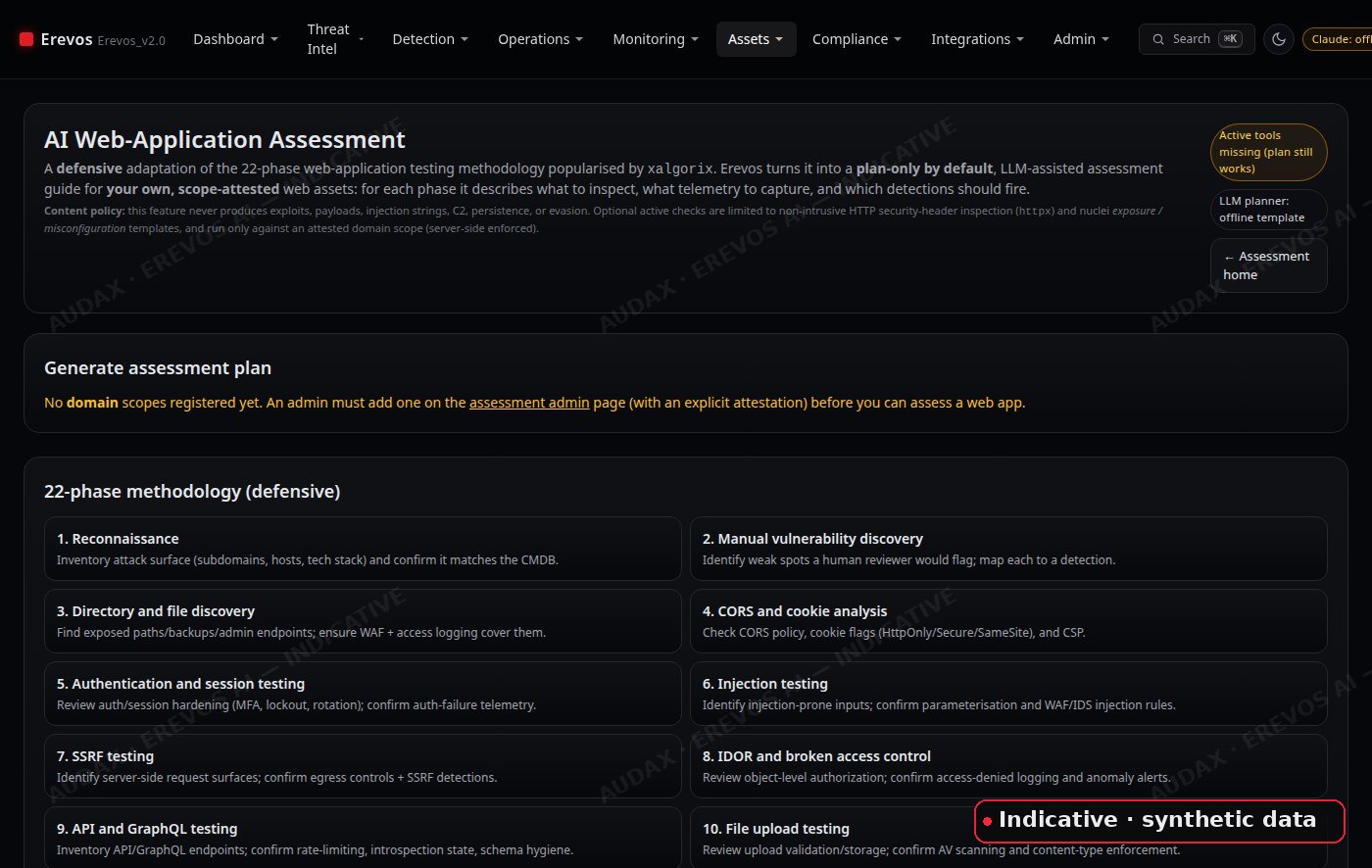
Erevos erevos.local / assessment / webapp LIVE
Offensive Security — 22-phase web-app assessment
02 / Validation

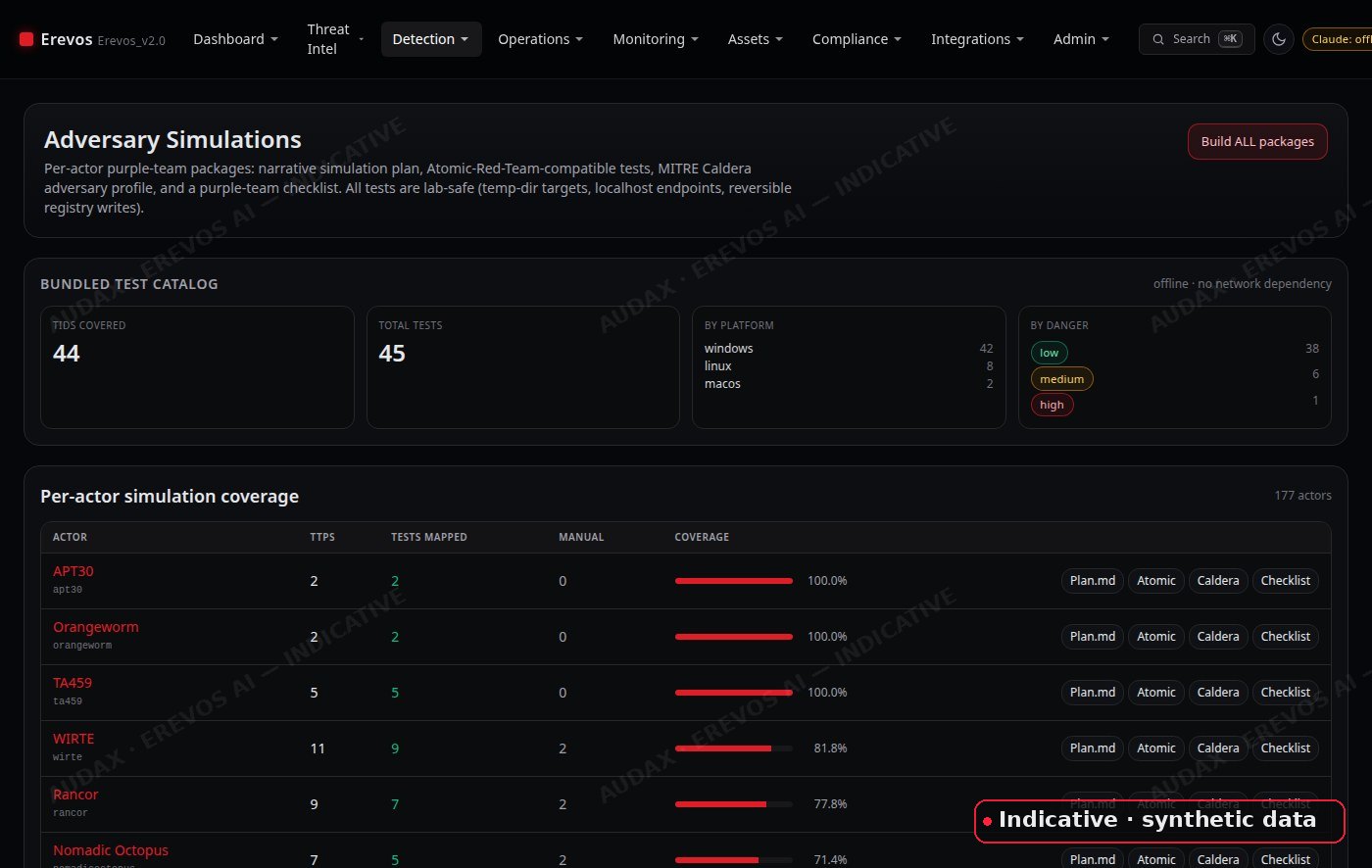
Adversary Validation Services

We validate in practice, on your own systems and endpoints, whether real attack techniques work: which weaknesses and paths are truly exploitable, where they lead and what a real adversary could achieve in your environment — with our own offensive engine and our own detection engine.

  • Adversary Emulation (MITRE ATT&CK)
  • Attack Path Validation
  • Exploitability Validation
  • Ransomware Readiness Simulation
  • Red Team Scenarios
Erevos erevos.local / simulations LIVE
Adversary Validation — purple-team simulations
03 / Continuous

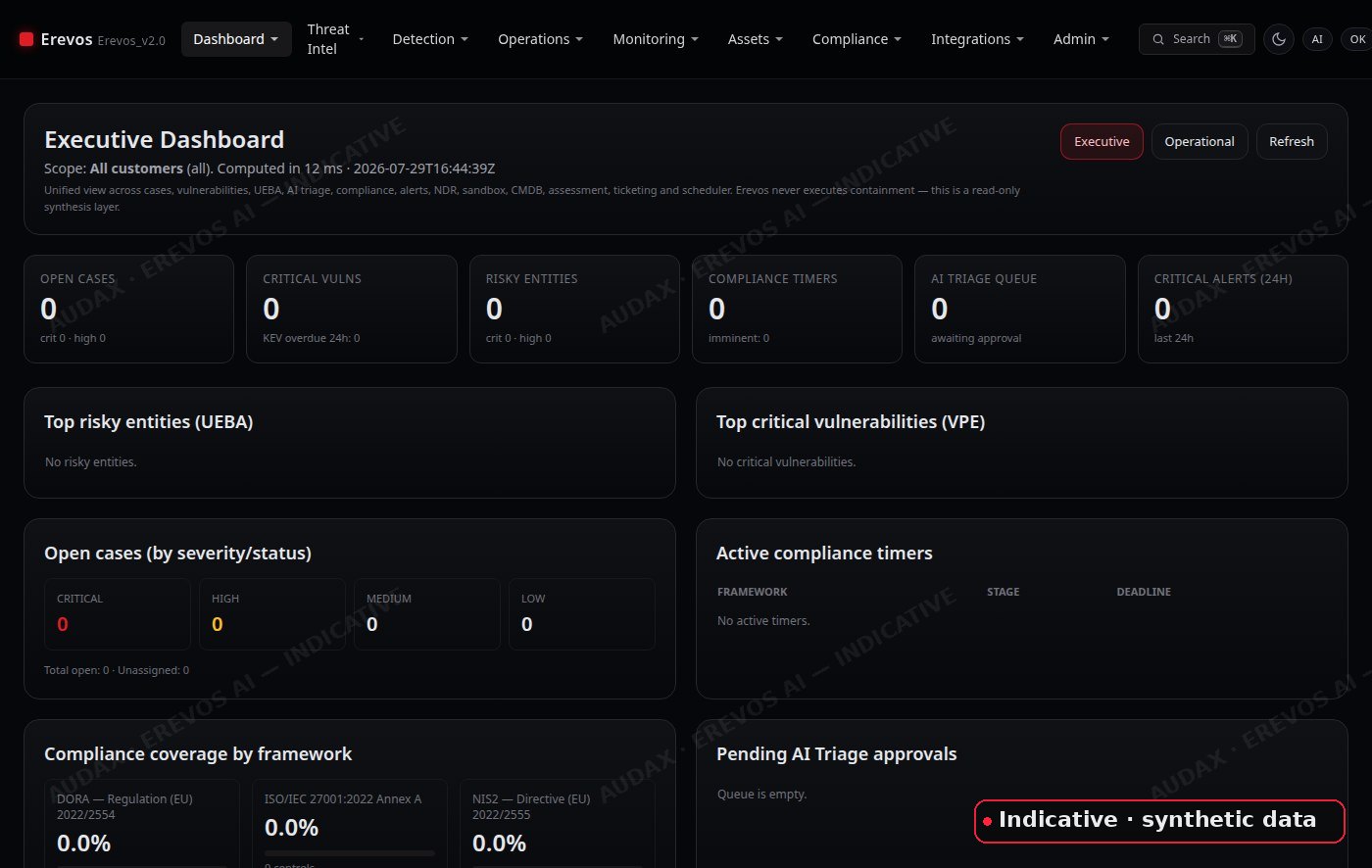
Continuous Offensive Exposure Management

We turn exposure management into a continuous process of technical validation: we map the attack surface, identify the exploitable exposure points, test them with controlled offensive techniques, prioritize them based on real risk and retest that the critical weaknesses have been closed.

  • Continuous Attack Surface Mapping
  • Vulnerability Validation
  • Adversary Scenario Testing
  • Risk-Based Remediation
  • Executive Evidence Reports
  • Retesting Automation
Erevos erevos.local / dashboard / executive LIVE
Continuous Exposure Management — unified dashboard
04 / Response

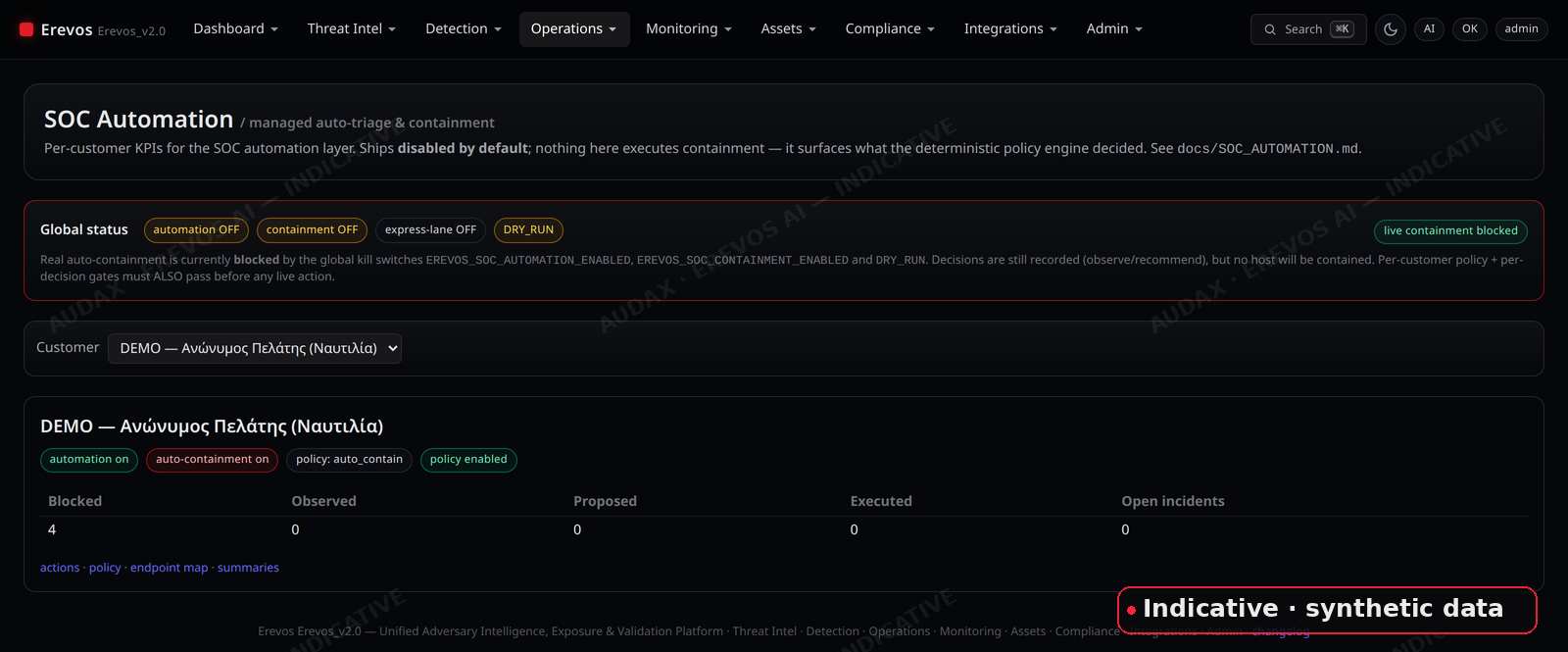
Automated Response & Containment

We take in your SIEM’s alerts, prioritize them automatically and, when strictly predefined conditions are met, we isolate the compromised workstation. The decision is made by a deterministic rules engine, not a language model, and every step is logged — even when the decision is “no action”.

  • Automated Alert Triage
  • Deterministic Containment Policy
  • Endpoint Isolation with Human Approval
  • Per-Organization Policies
  • CISO Notifications
  • Daily Summaries & Audit Trail
Erevos erevos.local / soc / overview LIVE
Erevos AI’s automated response console with the global safety switches
The offensive validation chain

From exposure to proof of resilience

Erevos AI turns exposure into technical proof of resilience. It covers the entire offensive chain, end to end, with every active test requiring explicit confirmation, approval and server-side verification of the scope before it runs. This way, every test stays safe, controlled and fully documented.

exposure discovery
Mapping of every externally accessible point: subdomains, hosts, open services, technologies and misleading or typosquat domains.
asset inventory
A live asset registry, with owners, users, interconnections and an immutable history of every change.
vuln prioritization
Transparent and explainable vulnerability prioritization with context, combining CISA KEV, FIRST EPSS, NVD, CMDB and an adversary catalog, with documentation for every score.
adversary TTP mapping
Linking every finding to MITRE ATT&CK techniques and profiles of 177 real threat actors, so that the technical finding gains real threat context.
safe assessment
Recon-grade checks and cloud adversary emulation with exclusively synthetic, non-destructive events, so that the assessment stays controlled and safe.
adversary validation
Detection rules in 13 detection formats, with approval-gated deployment and purple-team simulations that produce telemetry only, for safe validation of the defense.
reporting
Ready-made reports in HTML, Markdown, PDF, DOCX and STIX 2.1, a correlation graph and a documented GenAI assistant, based on the real findings and data of the assessment.
The core of Erevos AI

Capabilities that rarely coexist in a single Offensive Security engine

01 / Assessment

Offensive Assessment Engine

A controlled orchestration layer around established tools for reconnaissance, mapping and technical assessment. It supports nine different assessment profiles, from passive reconnaissance and Attack Surface Management (ASM) to AI-assisted Offensive Security assessments.

The active profiles operate by default in plan-only mode, with clear scope, allowlisted tools and mandatory review before any active action.

Passive ReconASMVulnerability AssessmentAI-Assisted Profiles
02 / Inventory

Continuous recording and history of assets

The exposure surface is turned into a constantly updated asset registry, which includes technical attributes, owners, users, business roles, interconnections and an append-only history of changes.

The connection with Network Access Control (NAC) systems works exclusively as a controlled outbound integration hook. Erevos AI does not by itself enforce access policies or enforcement on the network.

Asset InventoryOwnershipRelationshipsChange History
03 / Risk

Context-Aware Vulnerability Prioritization

Erevos AI’s vulnerability prioritization combines technical findings with data from CISA KEV, FIRST EPSS, NVD, the CMDB and the catalog of relevant threat actors.

The result is an explainable and prioritized remediation queue. Every priority is documented based on the likelihood of exploitation, the asset’s exposure, the business impact and the correlation with real adversary techniques and campaigns.

CISA KEVEPSSNVDRisk-Based Prioritization
04 / Threat Intelligence

Adversary TTP Knowledge Base

A structured knowledge base with 177 adversary profiles, aliases, geographic correlations, Tactics, Techniques and Procedures (TTPs), campaigns, malware families, runbooks and related vulnerabilities.

By importing a URL, threat report or other approved document, the specialized LLM identifies and proposes TTPs and Indicators of Compromise (IOCs). The information stays in an assessment state until it is reviewed and approved for import into the threat catalog.

MITRE ATT&CKThreat ActorsCampaign IntelligenceIOC Extraction
05 / Detection

Detection Generation & Purple Team Validation

Erevos AI turns threat information into proposed detection rules for 13 different detection formats and technologies.

The deployment of the rules is carried out only through an approval-gated process. Their effectiveness can be validated with safe telemetry-only Purple Team simulations, so as to prove what the defenses log and detect without requiring real malicious activity.

The supported formats cover SIEM, EDR, NDR/NIDS and host-based monitoring systems and are not limited to SIEM rules only.

SIEMEDRNDR/NIDSHost MonitoringApproval-Gated Deployment
06 / Cloud

Cloud Adversary Emulation

It includes 15 built-in assessment scenarios for AWS, Microsoft Azure and Google Cloud Platform, as well as a generator for detection rules in multiple formats.

The scenarios use exclusively synthetic events and controlled telemetry, so that the assessment of cloud and identity-based threats stays distinct from real production activity.

AWSMicrosoft AzureGCPSynthetic EventsIdentity Threats
07 / Attack Surface Management

External Attack Surface Discovery

Continuous detection and monitoring of domains that may be used for lookalike, typosquatting or brand-abuse attacks, through a specialized domain-permutation engine.

Watchlists, tagging, change history and risk-based prioritization are supported for critical domains and assets, so that changes in the external attack surface are detected and assessed systematically.

Domain MonitoringTyposquattingBrand AbuseWatchlists
08 / Deception

Honeytokens & Deception

Creation of controlled honeytokens and decoy documents that act as tripwires for the early identification of suspicious access or interaction.

When an unauthorized user or attacker interacts with the trapped content, a high-confidence event is triggered, which can feed the triage and Incident Response process.

HoneytokensTripwiresHigh-Confidence AlertsEarly Warning
09 / Reporting

Reporting & Executive Dashboard

Report generation in HTML, Markdown, PDF, DOCX and STIX 2.1, together with a link-analysis graph, a documented GenAI assistant and a unified executive dashboard.

The technical findings, the attack paths, the detection gaps and the remediation progress are turned into a clear risk picture for CISOs, technical teams, risk leaders and Management.

STIX 2.1Link-Analysis GraphExecutive DashboardEvidence-Based Reporting
AI Assessment Profiles

Multiple assessment profiles — Plan-Only by Default

The AI-assisted and Offensive Security profiles operate by default in plan-only mode. They do not perform active actions and do not trigger external tools without explicit selection and the required approval.

The bridges to external tools are exclusively opt-in and are controlled through explicit activation flags, which remain OFF by default. Erevos AI does not automatically import offensive packages and allows the execution of local commands only through allowlisted, approved tools appropriate for the given scope.

Passive

Passive reconnaissance with registration data, Certificate Transparency, DNS and other publicly available sources, without sending packets or active requests to the target.

ASM

Mapping of the external attack surface through established discovery engines, with asset discovery, tagging, change history and risk-based prioritization.

Vulnscan

Non-intrusive checks for technical indications of vulnerabilities and exposures, through approved templates and a clearly defined scope.

AI_Test

LLM-assisted design of defensive tests, validation scenarios and technical assessments. It produces a proposed test plan without autonomously performing the actions.

WebApp_AI

AI-assisted assessment of web applications based on a structured, multi-phase defensive methodology, with mapping of the application, test design and documentation of the results.

cai_agent

Cybersecurity AI Assessment Agent. It designs and monitors a kill-chain assessment through a recon-only bridge, without uncontrolled execution or autonomous exploitation.

redamon_loop

Offense-to-Remediation Loop. It connects offensive validation with the remediation process, using human-gated PR automation and mandatory review before every change to the code or the infrastructure.

AppSec_Autofix

It proposes fixes for Application Security findings and can create remediation pull requests through a PR-gated process. No change is merged or applied without human review and approval.

Offensive_Agent

An AI-assisted offensive assessment profile for the design and monitoring of an attack chain through a strictly restricted recon-only bridge.

It operates exclusively within the approved scope, without automatic active exploitation and without the ability to bypass the allowlists, the approval gates or the global kill switches.

WebApp_AI

AI Web Application Assessment — Structured multi-phase methodology

The WebApp_AI is a defensive adaptation of a structured, multi-phase web application assessment methodology. For each stage, the Erevos AI defines what must be examined, which telemetry and technical evidence must be collected and which detection mechanisms must be validated.

The process is strictly oriented toward defensive assessment. It designs and documents the required tests, without creating or executing exploits, malicious payloads or injection strings.

The methodology covers, from reconnaissance, authentication and injection-risk review to SSRF, IDOR, insecure deserialization and race conditions, with emphasis on the technical validation of the risks, on the visibility of the defense and on the prioritization of remediation actions.

The assessment is permitted only on a verified and approved domain scope. The scope is enforced at the server level, so that every planned or executed action stays strictly within the authorized field.

Erevos erevos.local / assessment / agent LIVE
AI Web-Application / CAI Assessment
For your technical teams · Dashboards for every function

The engine in a real usage environment

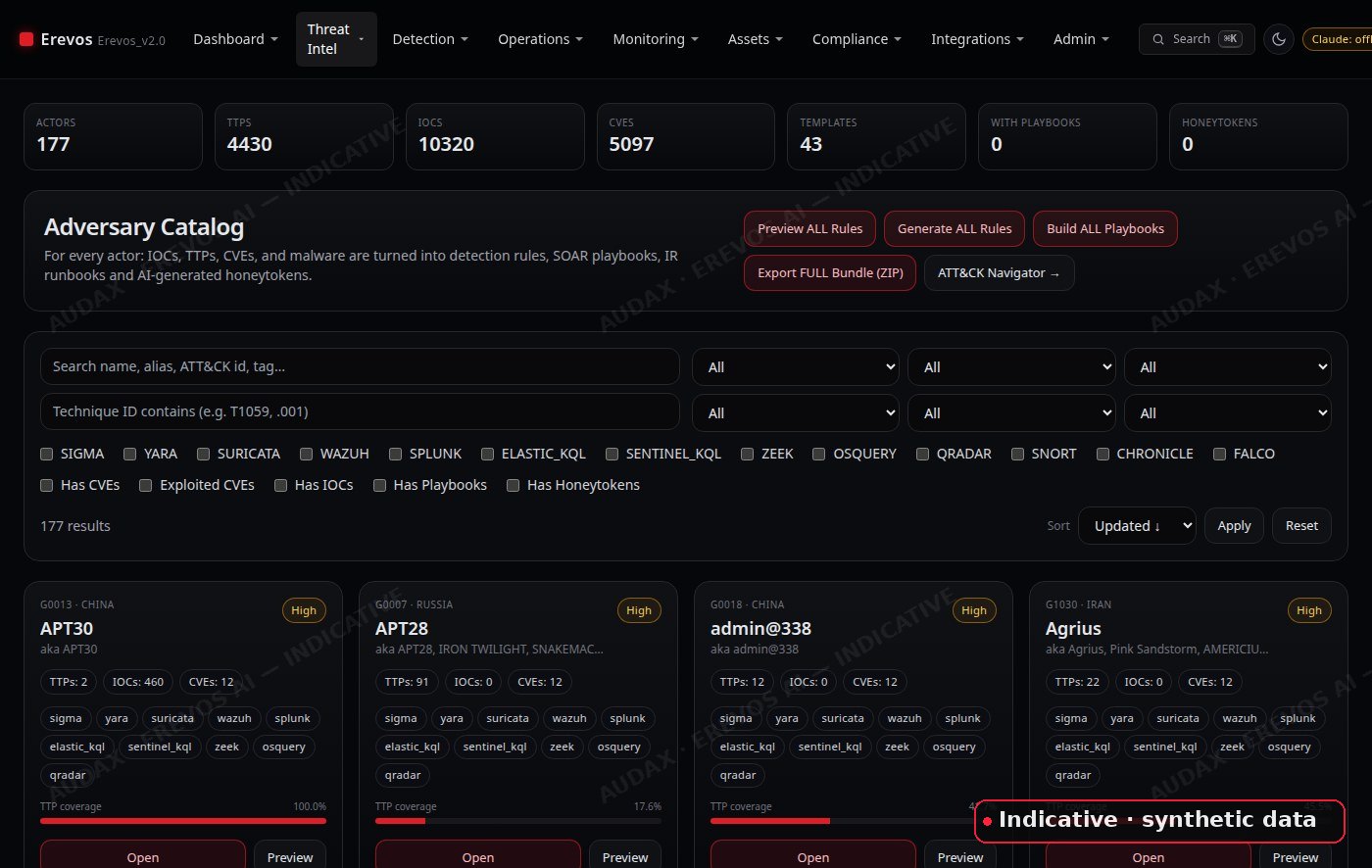
Adversary Catalog

Unified Operations Console

For every adversary, the IOCs, TTPs, CVEs and malware indicators are turned into practical operational deliverables: detection rules, runbooks and AI-generated honeytokens, through a single environment for use and export.

  • Dynamic filters by SIEM format, CVEs, IOCs, playbooks and honeytokens
  • Preview, Generate & Export Full Bundle to ZIP with one click, so that teams receive a ready-made utilization package for immediate operational use.
Erevos erevos.local / catalog LIVE
Adversary Catalog
Actor Deep-Dive

Full adversary profile with MITRE ATT&CK mapping

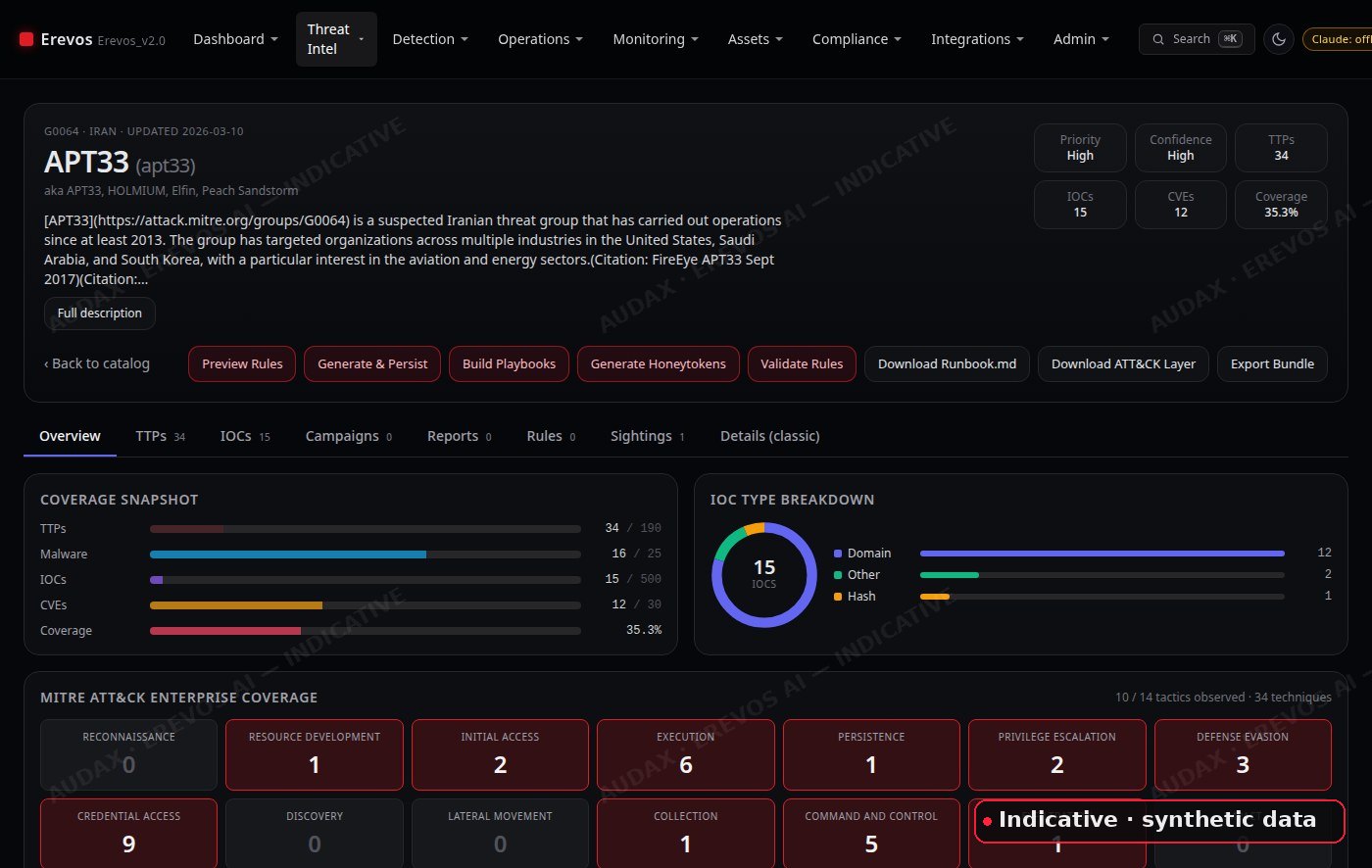
For every threat actor, the engine creates a full operational profile with mapping to MITRE ATT&CK — coverage snapshot, IOC type breakdown and immediate generation of detection content — giving a clear picture of what is detected and which gaps must be covered.

  • Priority, confidence and coverage percentage per threat actor, so that every adversary is assessed based on severity, the reliability of the data and the operational readiness of the defense.
  • Generate Rules / Build Playbooks / Generate Honeytokens / Validate Rules, for the immediate conversion of threat intelligence into detection rules, response playbooks, honeytokens and rule-validation procedures.
Erevos erevos.local / actor / apt33 LIVE
Actor deep-dive APT33
ATT&CK Navigator

Where to invest first in detection

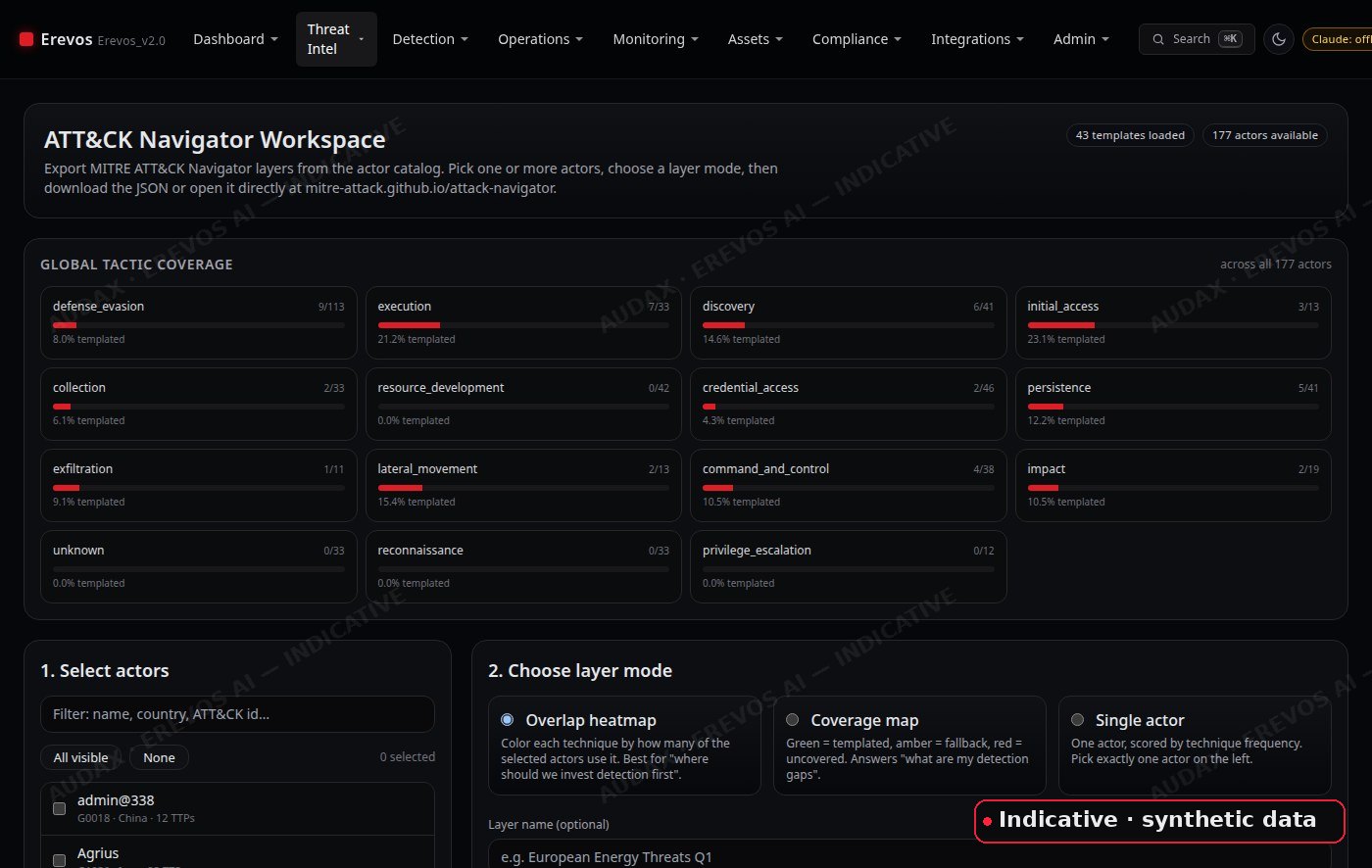
The engine captures the overall detection coverage per MITRE ATT&CK tactic and for all 177 threat actors — through an overlap heatmap, coverage map and single-actor mode — so that you know which techniques are covered, where there are gaps and where to invest first.

  • Detection density per tactic, such as defense evasion, execution, discovery, persistence and credential access, so that it is clearly visible where real operational coverage exists and where reinforcement is needed.
  • Export to JSON for the MITRE ATT&CK Navigator, with ready-made layers that can be used immediately for analysis, presentation, prioritization and defense-improvement planning.
Erevos erevos.local / navigator LIVE
ATT&CK Navigator
Cloud Adversary Emulation

The battlefield is Cloud-First & Identity-First

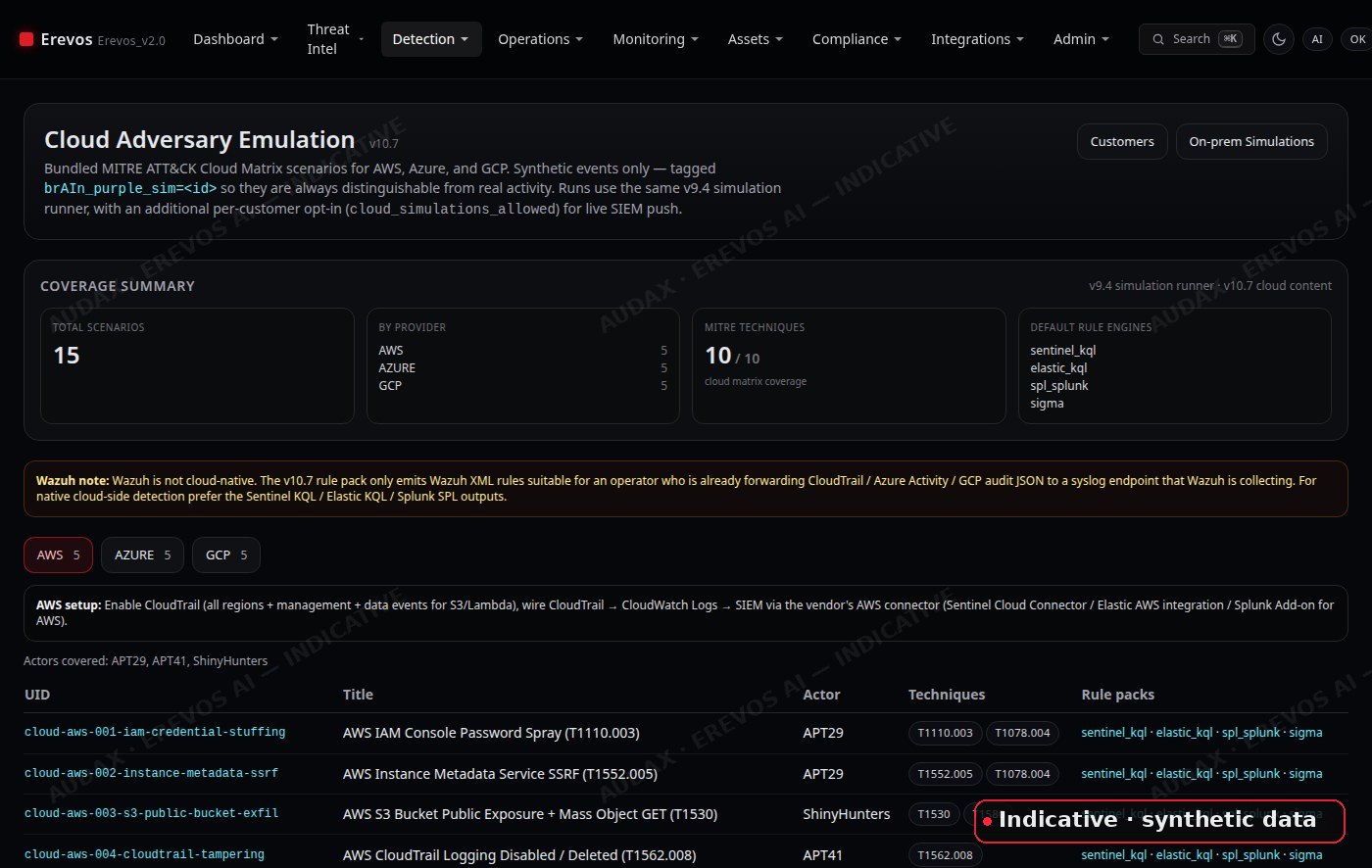
Erevos AI includes 15 bundled scenarios based on the MITRE ATT&CK Cloud Matrix for AWS, Azure and GCP, with synthetic events that are always distinct from real activity and with per-customer opt-in for live forwarding to a SIEM.

  • Rule packs in multiple detection formats, so that the scenarios can be used immediately in different SIEM and detection environments.
  • Scenarios inspired by adversaries such as APT29, APT41 and ShinyHunters, for realistic validation of the defense against cloud and identity-focused attack techniques.
Erevos erevos.local / cloud-emulation LIVE
Cloud Adversary Emulation
Autonomous Kill-Chain

Offensive Agents & CAI — Defensive Engagement Guide

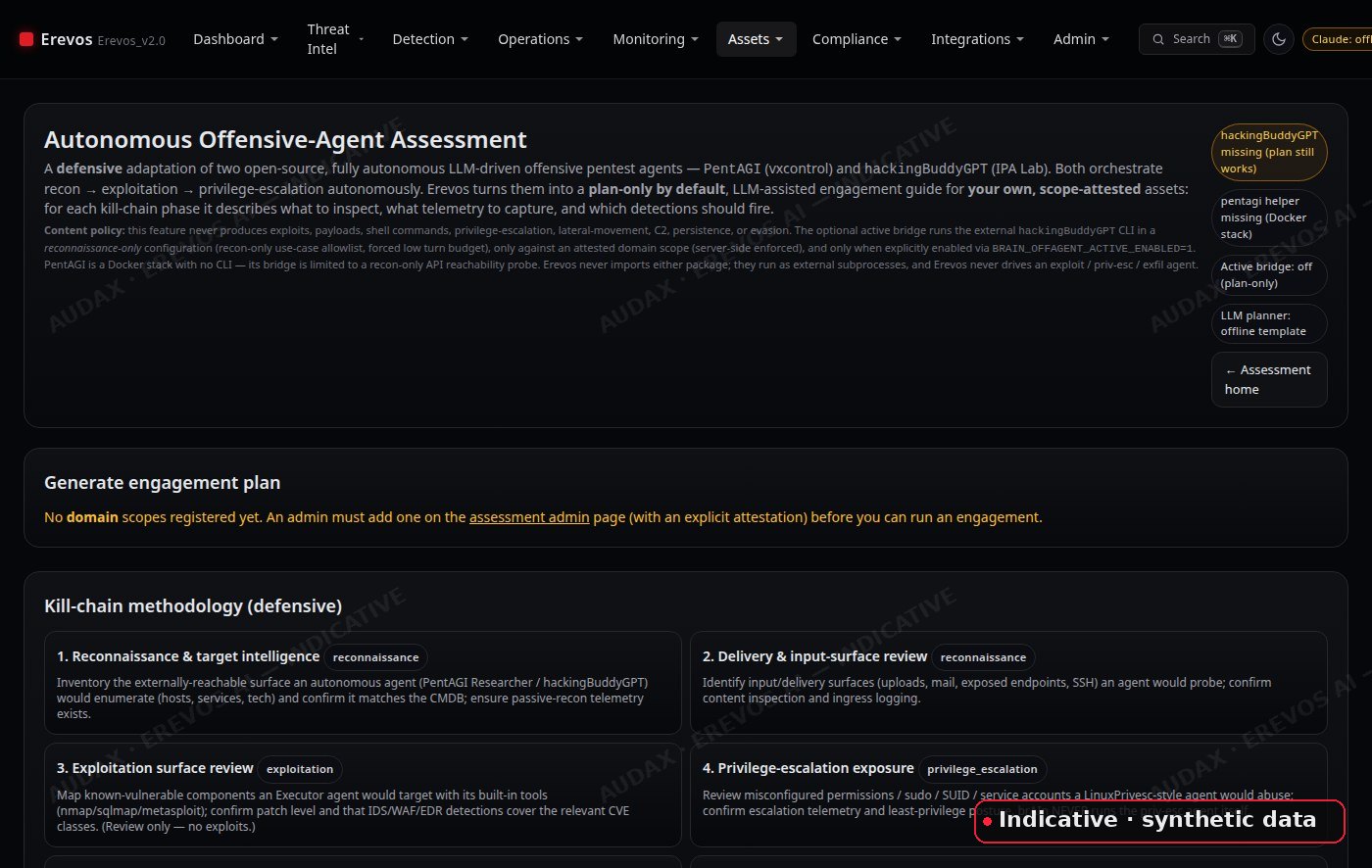
From Reconnaissance to Exfiltration, the engine helps security teams understand how a modern AI-assisted adversary could move and how the defense must prepare in order to detect it early.

  • Mapping per stage of the kill chain: Reconnaissance, Exploitation, Privilege Escalation, Lateral Movement and Exfiltration, with clear guidance for inspection, telemetry and detection readiness.
  • Safe execution architecture: Erevos AI never imports the agents’ packages. The tools are executed as external subprocesses, so that the assessment stays controlled, isolated and fully documented.
Erevos erevos.local / assessment / offensive LIVE
Autonomous Offensive-Agent Assessment
Offense-to-Remediation

Remediation Loop with Human-in-the-Loop PR Gate

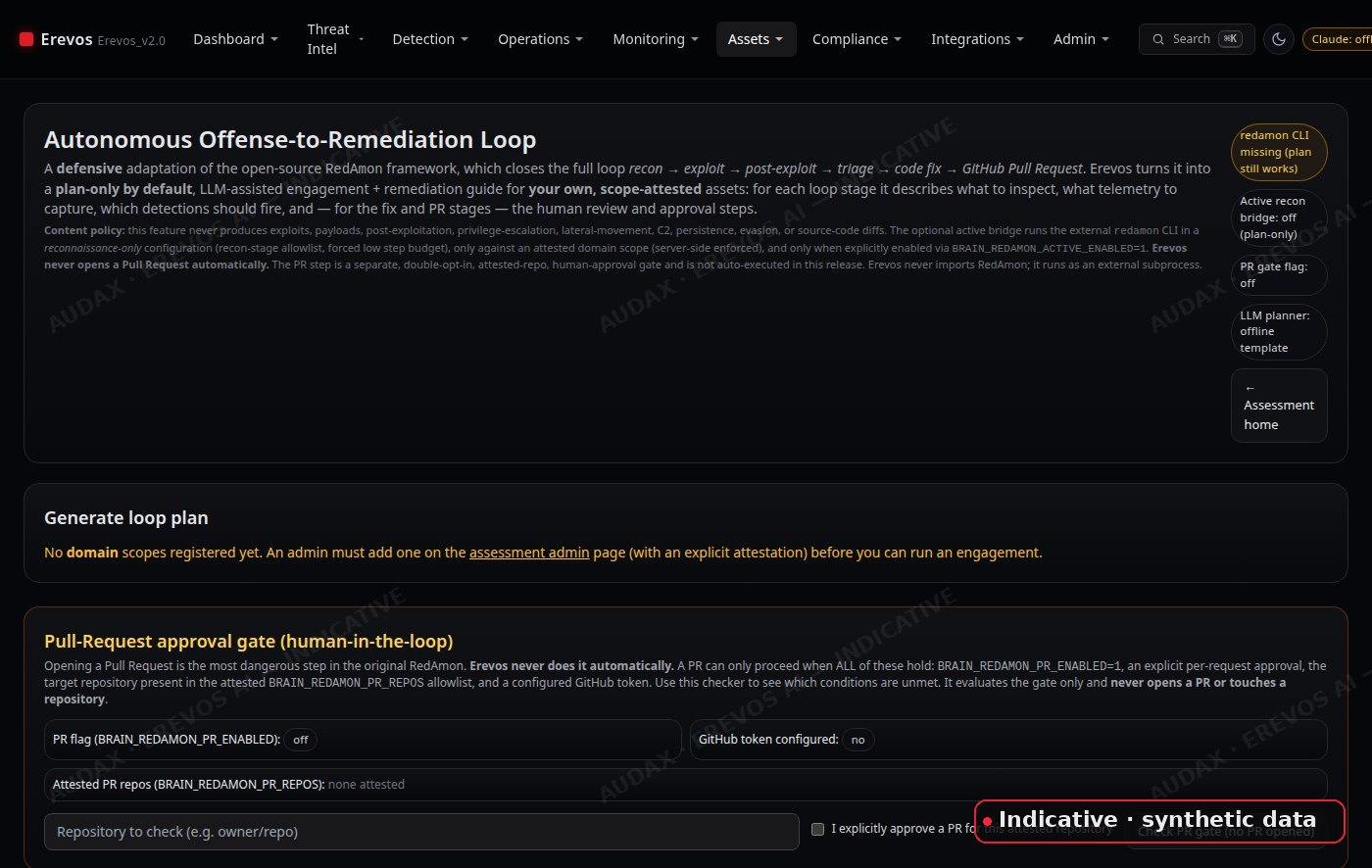
Erevos AI closes the full cycle of technical validation and remediation: recon → exploit validation → triage → code fix → GitHub Pull Request.

  • A Pull Request only when all prerequisites are in place: explicit human approval, a confirmed repository allowlist and an available GitHub token.
  • Double-opt-in, an attested repository and a human approval gate, so that every remediation action is controlled, documented and limited exclusively to the approved field of application.
Erevos erevos.local / assessment / remediation LIVE
Offense-to-Remediation Loop
Operational logic

From threat knowledge to operational utilization

1

Adversary intelligence

A unified catalog of threat actors with profiles, aliases, Tactics, Techniques and Procedures (TTPs), targeted sectors, campaigns, runbooks and related CVEs, so that threat information is turned into actionable operational knowledge.

2

Real risk assessment

Every CVE is correlated, with context, to the exploitation maturity, available Proofs of Concept, known active exploitation, related campaigns and real threat actors. This way, prioritization is not based only on the severity score, but on the real likelihood and business impact of an attack.

3

Detection as Code

Generation of proposed detection rules for on-premises, endpoint, network and cloud telemetry, in 13 different formats. In this way, threat information is turned into applicable detection mechanisms, with a controlled assessment and approval process before deployment.

4

Deception layer

Creation of honeytokens and decoy documents at points where an adversary would expect to find useful data or access. The deception elements act as early-warning tripwires, producing high-confidence alerts when there is unauthorized interaction.

5

Validation of the defense

Safe telemetry-only simulations and cloud adversary emulation scenarios confirm that the detection rules, telemetry collection and response procedures work as intended, without creating real malicious activity or unacceptable risk to the production environment.

6

A risk picture for Management

Unified reports with detection coverage, Attack Surface Management findings, documented risk prioritization, remediation progress and elements that can support regulatory documentation. This way, Management, the CISO and the risk officers make decisions based on real data, clear priorities and business impact.

NIS2 & DORA — Technical validation and auditable documentation

REGULATORY FRAMEWORK
Erevos AI for NIS2
See how the continuous cycle of mapping, assessment, technical validation and retesting produces evidence and documentation that can support the requirements for risk management and for assessing the effectiveness of the cybersecurity measures of NIS2 — without presenting the service as automatic or full compliance.
APT & Threat Intelligence

Adversary Scenario Library — 177 adversary profiles

The largest Greek library of tracked threat actors by Audax — each profile mapped to MITRE ATT&CK, with targeted sectors, malware/tooling and related CVEs. Each profile feeds the offensive engine Erevos AI for adversary emulation and technical validation based on real adversaries of the Greek & European landscape.

177Adversary profiles
MITREATT&CK mapped
EU · GRThreat landscape 2026
TTPsMalware · Tooling · CVEs

Threat Mapping

Which actors target your sector, with which TTPs and malware — mapped to MITRE ATT&CK.

Operational Utilization

The profiles feed Erevos AI for adversary emulation and validation based on real adversaries.

Intelligence-driven Defense

Prioritization of defensive controls and detection based on the actors that truly concern you.

Threat Actors Catalog176 profiles · MITRE ATT&CK
🇨🇳 ADMIN@338G0018🇮🇷 AGRIUSG1030🇮🇷 AJAX SECURITY TEAMG0130AKIRAG1024🇷🇺 ALLANITEG1000🇰🇵 ANDARIELG0138🇨🇳 AOQIN DRAGONG1007🇰🇵 APPLEJEUSG1049APT-C-23G1028APT-C-36G0099🇨🇳 APT1G0006🇨🇳 APT12G0005🇨🇳 APT16G0023🇨🇳 APT17G0025🇨🇳 APT18G0026🇨🇳 APT19G0073🇷🇺 APT28G0007🇷🇺 APT29G0016🇨🇳 APT3G0022🇨🇳 APT30G0013🇻🇳 APT32G0050🇮🇷 APT33G0064🇰🇵 APT37G0067🇰🇵 APT38G0082🇮🇷 APT39G0087🇨🇳 APT41G0096🇮🇷 APT42G1044🇨🇳 APT5G1023🇨🇳 AQUATIC PANDAG0143🇨🇳 AXIOMG0001BACKDOORDIPLOMACYG0135BITTERG1002BLACKBYTEG1043BLACKOASISG0063🇨🇳 BLACKTECHG0098BLUE MOCKINGBIRDG0108BOUNCING GOLFG0097🇨🇳 BRONZE BUTLERG0060CARBANAKG0008🇨🇳 CHIMERAG0114🇨🇳 CINNAMON TEMPESTG1021🇮🇷 CLEAVERG0003COBALT GROUPG0080CONFUCIUSG0142🇰🇵 CONTAGIOUS INTERVIEWG1052🇮🇷 COPYKITTENSG0052🇮🇷 CURIUMG1012🇮🇷 CYBERAV3NGERSG1027🇨🇳 DAGGERFLYG1034🇱🇧 DARK CARACALG0070🇰🇷 DARKHOTELG0012DARKHYDRUSG0079DARKVISHNYAG0105🇨🇳 DEEP PANDAG0009🇷🇺 DRAGONFLYG0035DRAGONOKG0017🇨🇳 EARTH LUSCAG1006🇨🇳 ELDERWOODG0066🇷🇺 EMBER BEARG1003🇺🇸 EQUATIONG0020EVILNUMG0120EXOTIC LILYG1011FEROCIOUS KITTENG0137FIN10G0051FIN13G1016FIN4G0085🇷🇺 FIN5G0053FIN6G0037FIN7G0046FIN8G0061🇮🇷 FOX KITTENG0117🇨🇳 GALLIUMG0093GALLMAKERG0084🇷🇺 GAMAREDON GROUPG0047GCMANG0036GOLD SOUTHFIELDG0115🇵🇰 GORGON GROUPG0078🇮🇷 GROUP5G0043🇨🇳 HAFNIUMG0125🇮🇷 HEXANEG1001🇰🇷 HIGAISAG0126INCEPTIONG0100INC RANSOMG1032🇨🇳 INDIGOZEBRAG0136🇷🇺 INDRIK SPIDERG0119🇨🇳 KE3CHANGG0004🇰🇵 KIMSUKYG0094LAPSUS$G1004🇰🇵 LAZARUS GROUPG0032LAZYSCRIPTERG0140🇮🇷 LEAFMINERG0077🇨🇳 LEVIATHANG0065🇨🇳 LOTUS BLOSSOMG0030🇨🇳 LUMINOUSMOTHG1014MACHETEG0095🇮🇷 MAGIC HOUNDG0059🇧🇷 MALTEIROG1026MEDUSA GROUPG1051🇨🇳 MENUPASSG0045METADORG1013🇨🇳 MOAFEEG0002🇨🇳 MOFANGG0103MOLERATSG0021🇰🇵 MOONSTONE SLEETG1036🇮🇷 MORELATS🌐 Unknown · Financial gain · AdvancedThe cybercrime actor Morelats has not been officially attributed to a specific entity. It is tracked with 12 linked CVEs (of which 4 critical). Motivation: financial gain. Sophistication: advanced.Related CVEs: 12MOSES STAFFG1009MOUSTACHEDBOUNCERG1019🇮🇷 MUDDYWATERG0069🇨🇳 MUSTANG PANDAG0129MUSTARD TEMPESTG1020🇨🇳 NAIKONG0019NEODYMIUMG0055🇷🇺 NOMADIC OCTOPUSG0133🇮🇷 OILRIGG0049ORANGEWORMG0071🇮🇳 PATCHWORKG0040🇨🇳 PITTYTIGERG0011PLATINUMG0068PLAYG1040🇱🇧 POLONIUMG1005POSEIDON GROUPG0033PROMETHIUMG0056🇨🇳 PUTTER PANDAG0024RANCORG0075🇷🇺 REDCURLG1039🇨🇳 REDECHOG1042🇨🇳 ROCKEG0106RTMG0048🇷🇺 SAINT BEARG1031🇨🇳 SALT TYPHOONG1045🇷🇺 SANDWORM TEAMG0034🇨🇳 SCARLET MIMICG0029SCATTERED SPIDERG1015🇹🇷 SEA TURTLEG1041🇵🇰 SIDECOPYG1008🇮🇳 SIDEWINDERG0121SILENCEG0091🇮🇷 SILENT LIBRARIANG0122🇳🇬 SILVERTERRIERG0083SOWBUGG0054🇷🇺 STAR BLIZZARDG1033🇦🇪 STEALTH FALCONG0038STORM-0501G1053STORM-1811G1046STRIDERG0041🇨🇳 SUCKFLYG0039TA2541G1018🇨🇳 TA459G0062🇷🇺 TA505G0092TA551G0127TA577G1037TA578G1038TEAMTNTG0139🇷🇺 TEMP.VELESG0088THE WHITE COMPANYG0089THREAT GROUP-1314G0028🇨🇳 THREAT GROUP-3390G0027🇨🇳 THRIPG0030TODDYCATG1022🇨🇳 TONTO TEAMG0131🇵🇰 TRANSPARENT TRIBEG0134TROPIC TROOPERG0081🇷🇺 TURLAG0010🇨🇳 UNC3886G1048🇮🇷 UNC788G1029🇨🇳 VELVET ANTG1047🇱🇧 VOLATILE CEDARG0123🇨🇳 VOLT TYPHOONG1017🇷🇺 WATER GALURAG1050WHITEFLYG0107WINDIGOG0124WINDSHIFTG0112🇨🇳 WINNTI GROUPG0044🇷🇺 WINTER VIVERNG1035WIRTEG0090🇷🇺 WIZARD SPIDERG0102🇨🇳 ZIRCONIUMG0128
Annual program

Erevos AI as an annual program — Audax Cyber Resilience Program

A pentest is a photograph; the adversary works in video. The Cyber Resilience Program unifies all of Audax’s services into a continuous cycle with a quarterly rhythm of proof — from exposure, to validation, to response and to documented progress toward the Board.

01 / Exposure

External Exposure Baseline

Mapping of the external exposure surface: leaked credentials, exposed services, forgotten systems and open entry points — the starting point of every program.

02 / CTEM

Erevos AI — Managed CTEM

Continuous Threat Exposure Management: the offensive engine maps, tests and prioritizes exposure in real time, with plan-only logic and review before every active action.

03 / Validation

Adversary Validation

Validation with real adversary TTPs (MITRE ATT&CK): we prove what is really detected and what is prevented — not what is supposed to work.

04 / Coverage

ATT&CK Coverage & Detection Content

From every offensive technique we execute, we produce a MITRE ATT&CK coverage map and ready detection content as a deliverable — what we achieved, which paths work and which detections close the gaps. Our own output, not a test of your tools.

05 / Red Team

Red Team & Social Engineering

Full-scope adversary simulation and human-risk campaigns, integrated into the annual cycle for a realistic test of people, processes and technology.

06 / Compliance

NIS2 & DORA Technical Documentation

Documentation and evidence package for NIS2 and DORA readiness — compliance documentation, not certification or guarantee.

07 / Board

Executive progress report

Every quarter, the Board sees progress in terms of risk and resilience — not technical PDFs: what improved, what remains, where the organization is heading.

08 / Evidence

Remediation & detection evidence

Proof that the findings were closed and confirmation through retest, together with an updated detection coverage map and a technical documentation file.

09 / Tiers

Essential · Advanced · Enterprise

The program scales: Essential for medium-sized organizations, Advanced for organizations with a SOC or regulatory obligations, Enterprise for critical infrastructure & groups.

IndependentProof, not promises
Platform add-ons

Erevos AI add-ons

Additional managed services that integrate into Erevos AI and extend coverage beyond the offensive engine — from email protection to guaranteed incident response.

Add-on / Email

Email Security Cloud

A fully managed cloud Email Security Gateway, in front of corporate email (Microsoft 365 / Google Workspace): five layers of protection before the message reaches the inbox.

Email Authentication (SPF/DKIM/DMARC), Domain Spoofing Protection, Mailbox Security Audit and Phishing Incident Response — email is the No.1 entry gate; it closes here.

Managed GatewaySPF/DKIM/DMARCAnti-PhishingM365 / Google
See the Email Security service →
Add-on / IR

Incident Response Retainer

Pre-agreed readiness and a guaranteed SLA: when the incident hits, you’re not looking for a team — you have playbooks, knowledge of the environment and immediate mobilization.

A full DFIR cycle (containment, eradication, post-incident report) with emphasis on NIS2 (24h/72h reporting) and offensive know-how that knows how the adversary moves.

Guaranteed SLADFIRNIS2 24h/72hPlaybooks
See the Incident Response Retainer →
Add-on / Deception

Erevos AI Node

A physical appliance (rack or desktop) that sets up a permanent, adaptive deception zone inside your network: decoy servers, shares, databases, honey credentials and trapped files that look like your own, without any real data.

No employee has any reason to touch them — so every contact is a high-confidence breach signal, with MITRE ATT&CK mapping and an almost ready investigation toward Erevos AI.

Adaptive DeceptionHoneytokensBreach DetectionRack / Desktop
See the Erevos AI Node →
Add-on / Exposure

External Exposure Baseline

Mapping of the external attack surface the way a real attacker sees it: exposed assets, services and weaknesses, with human confirmation and a prioritized 30/60/90 remediation plan.

The starting point before the continuous Erevos AI program — a clean, documented picture of your exposure in 5 business days.

External Attack SurfaceHuman-Validated30/60/90 PlanFrom €490
See the External Exposure Baseline →
Secure enterprise

14 risks, 14 solutions — complete annual coverage

The most common risks that threaten a business, each with its Audax solution — unified into one complete annual program, from a single partner, with predictable cost.

1 / 14

Your passwords may already be circulating on the internet

The risk: Corporate passwords, email addresses and other access credentials may have leaked from past breaches and may be sold today on illegal networks. In that case, the intruder does not need to breach any system. They log in using an employee’s real credentials, as if they were an authorized user.

Our solution: We check what an intruder can find out about your business: leaked passwords, exposed services, forgotten systems and open access points on the internet. We inform you immediately about anything that requires action and guide you to limit your exposure before it is exploited by an attacker.

2 / 14

Forgotten systems become the easiest entry point

The risk: An old server, a test website, a forgotten subdomain or a former partner’s account may remain active for years. Because no one is monitoring it, it is often one of the easiest entry points for an intruder.

Our solution: We record your business’s digital assets: websites, email, applications, cloud services, teleworking systems and older installations. We create a full map of your external exposure and help you decommission or secure anything that should not remain accessible.

You cannot protect something you don’t know exists.

3 / 14

The attacks on your sector are not random

The risk: Organized cybercrime groups often choose specific sectors, such as shipping, healthcare, accounting firms, tourism, manufacturing and technology. Once they identify an effective attack method, they repeat it across many businesses in the same sector.

Our solution: We study the techniques, methods and attack patterns used against businesses in your own sector. This way, our tests are not based only on generic vulnerability lists, but are tailored to the real adversaries and scenarios you are most likely to face.

4 / 14

One morning you may find all your files locked

The risk: A ransomware attack can encrypt invoices, contracts, customer records, accounting data and critical systems. Business operations are interrupted and the perpetrators demand money to restore the files or to not publish the data they stole.

The attack, however, usually started from a weakness that already existed.

Our solution: We carry out controlled Penetration Testing, with prior authorization and a clearly defined scope. We simulate the way a real attacker would try to get in, identify the path they could follow and show you which points must be fixed first.

5 / 14

Your website or e-shop may expose your customers

The risk: Your website, e-shop and web applications handle customer data, orders, user accounts and commercial information. A breach can lead to data loss, interruption of sales, legal obligations and a serious blow to your customers’ trust.

Our solution: We test your website, e-shop and applications the way an intruder would examine them. We investigate whether they can gain unauthorized access, intercept data, alter information or abuse user accounts.

For every finding we provide clear remediation instructions and prioritization based on real risk.

6 / 14

An email with a “new IBAN” can cost you thousands of euros

The risk: A seemingly normal email informs the accounting department that a supplier changed bank account. The invoice is real, the conversation looks authentic, but the money ends up in the fraudster’s account.

In many cases, the perpetrator had already gained access to a corporate email and had been monitoring the conversations for days or weeks.

Our solution: We check the security of your corporate email and cloud environment, such as Microsoft 365 and Google Workspace. We examine the access rights, the settings, the authentication mechanisms and the possible abuse scenarios of a compromised account.

Our goal is to reduce the likelihood of a breach and to limit the damage that a compromised account could cause.

7 / 14

A hasty click can open the door

The risk: An employee receives an email that appears to come from a bank, customer, supplier or partner. The message creates pressure and asks for immediate action. A click or the entry of a password can give the intruder the access they need.

Our solution: We carry out controlled phishing simulations, without real risk to the business. We measure how staff react to realistic scenarios and identify which departments or teams need additional training.

You don’t rely on assumptions. You gain a real picture of your staff’s readiness.

8 / 14

You may be paying for security systems that don’t protect you

The risk: Antivirus, firewall, EDR and monitoring systems are paid for and renewed every year. However, installing them does not automatically mean they are configured correctly or that they will detect a real attack.

Many businesses discover their gaps only after the breach.

Our solution: We use real attacker techniques, in a controlled and safe environment, to prove which techniques actually work in your environment and where they lead.

We show you what works, what goes undetected and which settings must be improved, so that your investments in cybersecurity have a real effect.

9 / 14

The problems left “for later” become tomorrow’s breaches

The risk: Most attacks do not necessarily rely on unknown or sophisticated techniques. They often exploit known weaknesses that were not fixed in time, because they got lost inside large technical reports or because there was no clear order of priority.

Our solution: We don’t just hand you a list of problems. We give you a practical action plan:

  • what must be fixed immediately,
  • what the real business risk is,
  • what can be scheduled for later,
  • which corrective action is required.

After the fix, we carry out a retest to confirm that the problem has been addressed correctly.

10 / 14

Your staff is not to blame — they need the right preparation

The risk: Attackers do not target only systems. They target people. They use fake phone calls, messages that appear to come from management, urgent payment requests and deceptive emails.

Without practical training, even an experienced employee can be deceived.

Our solution: We train your staff in Greek, with simple language and real examples. Employees learn to recognize suspicious emails, deception attempts, dangerous requests and incidents they must report immediately.

A properly informed employee can prevent an attack before it develops into an incident.

11 / 14

The audit done last year does not cover today’s changes

The risk: Cybersecurity is not an action taken once a year. Every new system, application, partner, account or misconfiguration can create a new point of exposure.

Between two annual audits, months can pass without a meaningful picture of the risk.

Our solution: With Erevos AI and continuous exposure management, we monitor the changes that affect your business’s external attack surface. New systems, exposed services, significant vulnerabilities and dangerous changes are detected and assessed without waiting for the next annual audit.

Security is transformed from a one-off project into a continuous process.

12 / 14

In an incident, every minute of delay increases the damage

The risk: From the moment an intruder gains access, they can move quickly: search for passwords, intercept data, create new access or expand to more systems.

The later the activity is detected, the greater the financial and operational damage can become.

Our solution: We combine technology, processes and human assessment to detect critical changes and risk indicators early. The findings are assessed, prioritized and turned into specific response actions.

You don’t just receive technical alerts. You receive a clear picture of what is happening, how serious it is and what must be done next.

13 / 14

On the night of the incident you must know who to call

The risk: When a serious incident occurs, many businesses start looking for help at the moment of the crisis. Every hour of delay can increase downtime, data loss and the total cost of recovery.

The external partner who is found at the last minute also needs time to understand the business’s environment and systems.

Our solution: With a predefined readiness agreement, you know in advance who takes charge, with which process and what the first response steps are.

Since we already know your environment, we can start from the essence of the incident, not from the initial introductions and the collection of basic information.

14 / 14

After the incident you must prove what you had done before it

The risk: After a serious breach, questions may follow from customers, partners, insurance companies, management or the competent authorities. For businesses subject to regulatory requirements, such as NIS2, it is not enough to declare that they took measures. They must be able to present documentation.

Our solution: Our services produce organized evidence for:

  • what was tested,
  • which problems were identified,
  • what the real risk was,
  • which fixes were proposed,
  • what was fixed and when,
  • which points were retested.

This way, a practical documentation file is created that supports management, the IT officers and the compliance processes.
Scenarios by sector

See Erevos AI in scenarios from your sector

Sixty-six anonymized and representative Erevos AI scenarios across ten sectors capture how Erevos AI identifies the threat, validates the defense and prioritizes the response, always with human approval at every critical action.

Pharmaceutical Sector

Unauthorized access to a cloud database

How Erevos AI detects access without authorization to a pharmaceutical company’s cloud database and helps in the immediate assessment of the real risk.

Cloud DB Breach
Financial Sector

Stopping ransomware before systems are locked

How Erevos AI detects early signs of ransomware in a financial organization and supports timely response before an operational interruption occurs.

Ransomware
Hospital Sector

Data leak from an insider threat

How Erevos AI detects suspicious internal activity and possible exfiltration of sensitive data in a hospital environment.

Insider
Energy Sector

Abuse of credentials and secrets

How Erevos AI detects mass retrieval or suspicious use of credentials in an energy organization, before the access turns into a critical incident.

Credential Abuse
Public sector body

Remote-access tool and malicious activity

How Erevos AI detects invisible remote access, a suspicious operator and signs of RAT malware in a public-sector environment.

RAT / Malware
SaaS Provider

Kubernetes API abuse

How Erevos AI detects suspicious activity and possible abuse of the Kubernetes API at a technology provider.

Kubernetes Abuse
Shipping Sector

Phishing, BEC and credential theft

How Erevos AI detects phishing, Business Email Compromise and credential-theft attempts at a shipping company.

Phishing / BEC
Insurance Sector

Supply-chain implant in a trusted tool

When the threat enters through a tool considered trusted, Erevos AI helps in identifying suspicious behavior, possible tampering and operational risk.

Supply Chain
Frequently asked questions

Erevos AI — Frequently asked questions

What is Erevos AI and how does it differ from a classic SOC?
Erevos AI is the proprietary engine of Audax Cybersecurity that unifies threat intelligence, offensive validation and response management into a single flow. A classic SOC monitors and alerts. Erevos AI first proves, with controlled techniques, how you can be breached by real adversary techniques mapped to MITRE ATT&CK, and then takes over the response line: automated triage, deterministic containment policy and a full audit trail for every decision.
What does the defensive side of Erevos AI include?
Beyond offensive validation, Erevos AI covers automated triage of alerts at the Tier-1 level, incident management, execution of response playbooks, endpoint hunting, entity behavior analytics (UEBA), network telemetry analysis, dynamic analysis of suspicious files in an isolated environment and generation of detection rules in 13 formats. Every active action passes through an approved policy and human approval.
Does Erevos AI carry out attacks on its own?
No. Erevos AI is safe-by-design: every offensive action requires human approval (human-in-the-loop) and is executed in a controlled way, within a verified scope with server-side enforcement. The AI and offensive profiles operate by default in plan-only mode and the bridges to external tools remain disabled until they are explicitly enabled.
Does Erevos AI replace our SOC?
No. Erevos AI automates the Tier-1 line: it receives the alerts, prioritizes them and applies a predefined isolation policy when strict conditions are met. Decisions that require human judgment stay with your team, with a full audit trail at every step.
Can the AI isolate a machine on its own?
No. The language model’s contribution is strictly advisory and does not enter the decision engine. Isolation is decided exclusively by a deterministic eleven-gate policy, every destructive action requires human approval, and the mechanism is delivered disabled in simulation mode.
How are access and control over Erevos AI itself secured?
Single sign-on via OIDC or SAML, multi-factor authentication, role-based permissions management, a full audit log of user actions and system health monitoring are supported. Each organization’s data stays strictly separated: one incident never touches another organization’s data, endpoints or recipients.
How does Erevos AI connect with the Adversary Scenario Library?
The Adversary Scenario Library feeds Erevos AI with scenarios based on tracked actors, mapped to MITRE ATT&CK. You select the adversary that concerns you and Erevos AI proves in a controlled way how it could breach you and which paths are exploitable.
Does Erevos AI cover NIS2 / DORA reporting requirements?
Erevos AI produces technical evidence, executive reporting and auditable control-validation documentation, which can support the risk management, incident management and reporting requirements of NIS2 and DORA. The service does not by itself constitute compliance, a legal opinion or a certification.
Contact

Request an assessment from our team

B2B only. Use a corporate email. The information you submit is not shared with third parties and is used exclusively for our communication regarding your request.

Ζητήστε δωρεάν αξιολόγηση